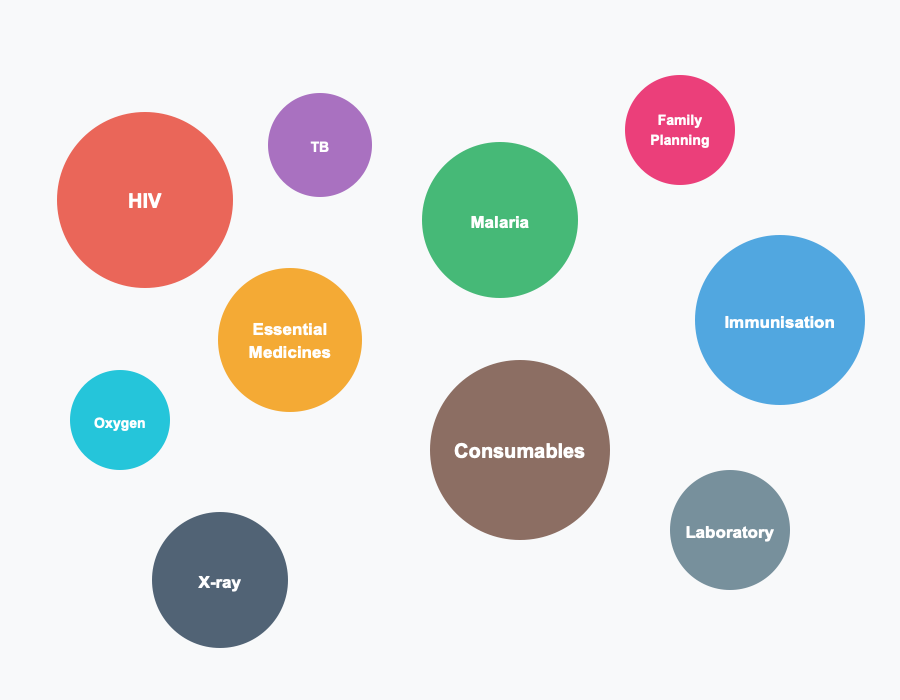
For as long as mSupply has been around, funders have been funding and encouraging parallel health supply chains. They’re often called “vertical programmes”.
We get it: your mandate is to improve the health of population X – defined either by a having a particular disease (HIV, Malaria, TB), or needing a particular type of prophylaxis (vaccines), or belonging to a particular demographic group (e.g. needing reproductive health commodities).
To fulfill your mandate, the supplies need to reach the people who need them. The country’s own health supply chain is broken, and you don’t have authority to fix it. Your only option is to create your own.
But, what if, having created 6 or more parallel supply chains, the funding dried up, as it (almost) did in January 2025? You walk away leaving the country with a system that is more cumbersome, more costly and more wasteful than if there was one integrated supply chain.
The good news is that funders are now very aware of this.
Take the USG’s America-First Global Heath Strategy – it really really doesn’t like parallel health supply chains:
See here:
our health foreign assistance programs in particular have become inefficient and wasteful, too often creating parallel healthcare delivery systems
and:
In many cases, countries – often with U.S. funding and encouragement – have developed overly complex and often parallel, disease-specific data monitoring systems that are outside of or only loosely connected to the country’s broader health information systems. While these parallel systems were often necessary in the early stages of the epidemics to guide the scale-up of effective health interventions, running parallel data systems is not an effective long-term strategy.
and:
Historically, U.S. health assistance programs, especially PEPFAR, often relied on parallel structures including parallel commodity procurement mechanisms, parallel distribution networks, program-specific healthcare workers, and program-specific data systems. This parallel infrastructure is one of the reasons that outcomes improved so quickly but also will not be sustainable for recipient countries to maintain long-term.
And in December 2025, The Global Fund has published a Procurement and Supply Chain Management Technical Brief that says:
Countries should accelerate implementation of interoperable, disease-agnostic supply chain information systems that enable end-to-end visibility
and
Priorities include … disciplined retirement of duplicative, program-specific tools
and in a workshop for West Africa in March 2026 they state
accelerating this impact now requires a decisive shift:…. Moving from fragmented, vertical programs
So?
Ironically, vertical supply chains were often well enough funded to pull the best staff away from the government’s own efforts, making the very problems they criticised that much worse.
We’re thrilled that integration is now on the agenda. It makes sense, and it turns the focus towards building national capacity, rather than doing the work on behalf of countries. This is hard, but good.
Open mSupply is the right tool for integrated supply chains
We would say that! But, we think it’s true. Here’s why Open mSupply makes sense:
- You can configure multiple “stores” at a single facility. That allows vertical programs to still run all their stores within Open mSupply, still separate, but at least within the one digital system.
- We support many of the program-specific features needed to support (say) immnisation, or family planning-specific supply chains. This is an enabler of combining into one system.
- Open mSupply has tools that allow you to merge stores, so you can combine data into a single system when the time is right.
- We’re building a product catalog that will allow different managers to manage just the items they’re responsible for, but maintain a single integrated catalog.